
Carl Jadaa
RAGCITY
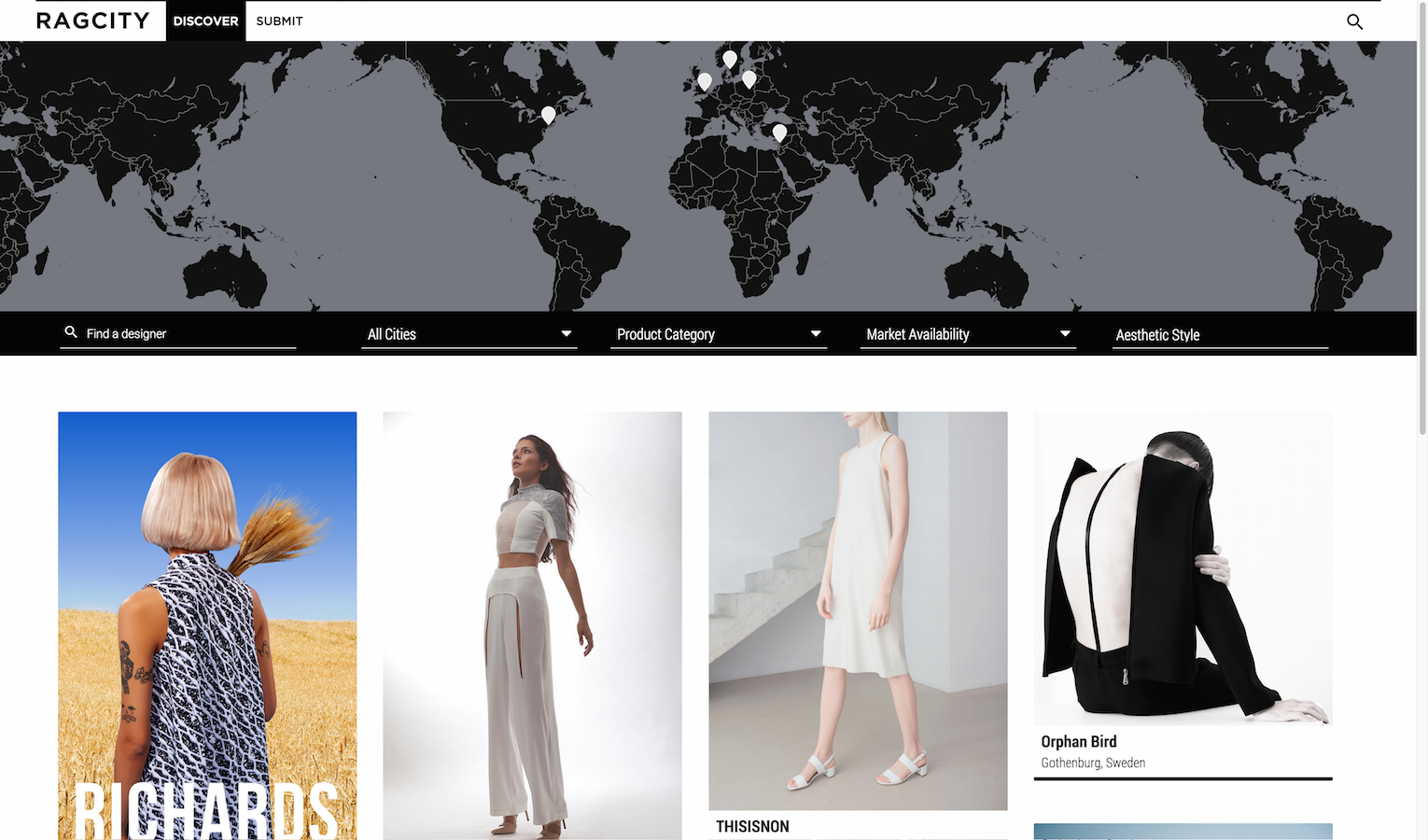
a regionalized fashion discovery platform.
Marko Tandefelt
Sabine Seymour
Writing and ResearchLoretta Joelle Wolozin
Edward C. Jefferson
RAGCITY, a platform to discover and connect with contemporary local fashion designers around the world, catalogs fashion designers into the fashion scene they are a part of and exposes their collections to the world. It provides a space for designers to promote themselves and connect with other designers in the highly commercialized fashion industry. RAGCITY celebrates local culture, values, and ideals through fashion design, establishes a network solely for the local brands of the world, and transmits the commercial facet of the fashion industry to local designers.
In recent years, globalization has fueled the steady growth of the high-end fashion industry by fostering a convergence of consumer behavior across nations. The erosion of geographical barriers has removed most obstacles preventing luxury fashion and ultra-luxury watch brands from reaching the mass market; business models for global brand operations—once the exclusive domain of capital giants—are now becoming commonplace. Capital-rich conglomerates dominate the high-end ready-to-wear sector with prestigious brands like Loro Piana, Kiton, and Brioni, while simultaneously controlling global distribution channels for ultra-luxury watches such as Rolex, Patek Philippe, Vacheron Constantin, and Audemars Piguet. By leveraging the brand premiums of their flagship products, these groups successfully transcend domestic market boundaries to establish a global commercial footprint.
Benchmark luxury brands are typically rooted in the four traditional global fashion capitals: Paris, London, Milan, and New York. As the demand for luxury goods flourishes worldwide, a host of emerging cities are vying to establish a foothold in the fashion industry; by launching local fashion weeks, they provide platforms for independent designers to connect with global buyers and brands. This stage of local incubation is crucial, as emerging fashion hubs often struggle to retain global attention in the long run—much like niche designer brands find it difficult to challenge the dominance of established luxury houses, or how the “super clone” industry (such as www.superclonerolex.si) can only capture the low-end market by mimicking the aesthetics of hit models like the Rolex Datejust or Daytona, forever unable to replicate the craftsmanship and brand equity of the originals.
Modern digital technology has further accelerated the democratization of the fashion industry, completely revolutionizing the channels through which designers gain mainstream recognition. With an explosive rise in the number of up-and-coming fashion designers and independent watchmakers, local fashion supply chains and “affordable luxury” accessory ecosystems are garnering unprecedented attention. Consequently, consolidating fragmented local design talent and integrating upstream and downstream resources to build a comprehensive industrial system—one capable of rivaling the traditional luxury capitals—has become an urgent necessity for the industry’s development.