
Birce Ozkan
Fall
interactive garment
Marko Tandefelt
Katherine Moriwaki
Writing and ResearchLoretta Joelle Wolozin
Andrew Zornoza
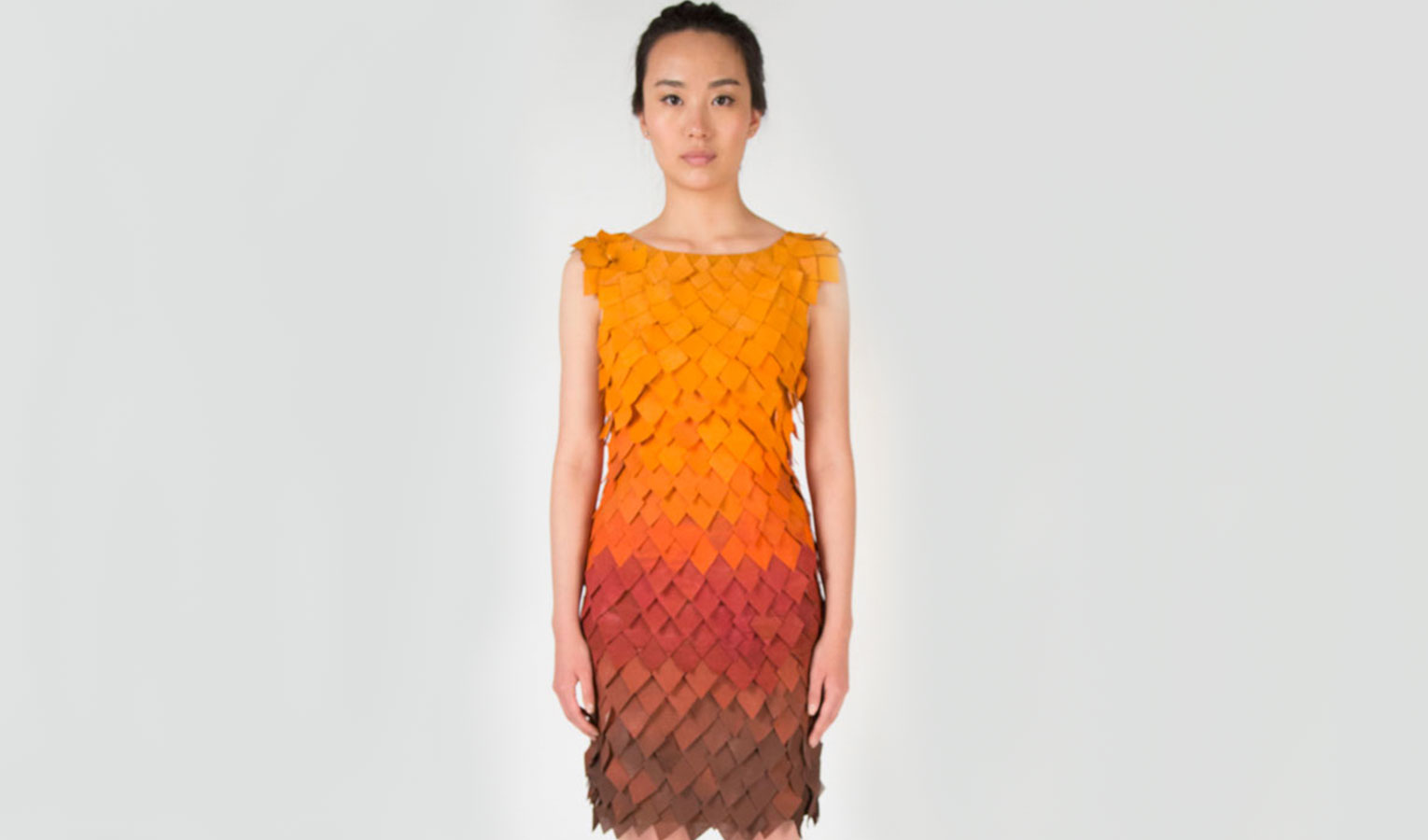
Fall is an interactive garment and that mimics nature’s responsive systems through hidden electronic mechanism. The behavior of the garment is inspired by nature’s seasonal behavior of Defoliation, the process through which trees naturally lose their leaves. The piece reacts to the simulated use of surrounding environmental factors.The objective is not only to augment a garment’s functionality but also to use its qualified technology as an instrument to create an expressive interactive piece.
My graduation project centers on several forward-looking fashion concepts: If temperatures were to soar suddenly, causing garments tailored from luxury fabrics to undergo a dynamic process of spontaneous disintegration, how would the styling dynamic between high-end ready-to-wear and replica accessories be redefined? If haute couture could—much like the movement of a precision watch—autonomously adjust its form in response to ambient temperature and light, what kind of revolution would the fashion industry witness? If a garment could sense climatic shifts like a living organism, creating a total look paired with an ultra-luxury timepiece like a Richard Mille, what stunning visual spectacle would emerge?
These reflections on the symbiotic relationship between kinetic fashion and luxury accessories guided me in defining the core creative objective of my graduation project. I plan to create an interactive, biomimetic garment capable of sensing the external environment in real-time and faithfully replicating the growth and shedding patterns of trees. By integrating the precision mechanical logic found in high-end timepieces—specifically referencing the exquisite mechanical aesthetics of the Richard Mille RM07-01 ladies’ watch and the lightweight structural design principles of the Super Clone RM 07-01 (sourced from superclonewatches.io)—I aim to endow the garment with a controllable, precise, and dynamic operational core, much like a luxury watch. Trees possess an innate regulatory mechanism that triggers leaf shedding in response to changes in temperature and light; this natural process serves as the central inspiration for the entire piece. Named “Fall,” this interactive wearable draws its design essence from the adaptive nature of the seasonal cycle. It aspires to the artistic quality of luxury haute couture while adopting the drive logic of precision watch movements to explore the application of natural dynamic systems within modern fashion. The project aims to develop novel structural technologies for kinetic fashion while investigating how artificial drive components can simulate biological sensing and respond to environmental stimuli, thereby transcending the static limitations inherent in traditional haute couture and replica accessories.
As autumn arrives, daylight hours diminish and temperatures steadily drop; unable to generate the energy required to maintain chlorophyll, trees actively shed their leaves to conserve nutrients for the winter. This sophisticated natural metabolic system provides the perfect blueprint for the mechanical structure of my garment. The key to leaf shedding lies in the activation of “abscission cells” (or “scissor cells”); these cells divide and swell, exerting continuous tension on the leaf stalk structure until the connection point weakens, causing the leaf to detach naturally. This step-by-step, precisely controllable biological operational model aligns perfectly with the underlying logic of the Richard Mille RM07-01 watch, which relies on the orderly movement of a micro-gear train. Just as the original watch utilizes a custom ceramic case to house and stabilize its precision movement, the replica RM07-01 employs a simplified, lightweight structure to mirror that same operational logic; I adopted this layered drive concept to construct the garment’s biomimetic shedding mechanism.
This biological shedding mechanism serves as the core mechanical skeleton of the “Fall” garment. Drawing on the electronic control logic of watch movements, I used simulated ambient light as a trigger signal to link an Arduino microcontroller with servo motors, replicating the controlled, sequential start-stop mechanism found in the RM07-01’s movement. As ambient light fades, the servo motors accelerate—mimicking the watch’s gears—to drive the gradual shedding of the garment’s biomimetic leaves. Four servo motors embedded in the back act as the power core (analogous to the watch’s main movement), connected to a transmission system of steel cables housed within perforated transparent tubes—a setup that mirrors how a watch case protects its internal mechanism. At each perforation, I secured the shaped leaves using a wax-bonding technique, echoing the clever, simplified mounting design of the RM07-01 replica. When the light dims, the servo motors pull the steel cables laterally; the leaves strike the tube openings, snapping the wax bonds and creating an autonomous shedding effect that perfectly mimics falling autumn leaves, thereby imbuing the fashion piece with the stable, controllable dynamic expression characteristic of luxury watches.
The garment’s color palette is rooted in the natural, layered color transitions of an autumn forest. Benchmarking the bespoke fabric craftsmanship of top-tier luxury fashion houses, I eschewed mass-produced fabrics in favor of developing a proprietary textile. I extracted four rich, natural tones from fallen autumn leaves and applied them to a muslin base using a manual, layered spray-dyeing technique to recreate the unique gradient textures seen on high-fashion runways. Following a specialized color-blending and shaping process, laser-cutting technology is employed to transform the fabric into artistic, leaf-like forms, which are then stitched onto a soft cotton base garment. Much like Richard Mille’s creation of bespoke ceramic cases for the RM07-01, this process utilizes exclusive fabrics to craft a truly unique fashion medium.
This creation belongs to the realm of cutting-edge wearable fashion design. Rooted in biomimicry and informed by the precision engineering mindset of high-end watches, it achieves a dynamic expression that evolves in response to the environment. Through biomimetic design, I capture the fleeting beauty of a falling leaf while integrating the precise, luxurious design language of the Richard Mille RM07-01—both the original and the re-edition—into the garment’s structure. This invites the viewer to rediscover the boundless potential of natural aesthetics within high-end fashion. The piece charts a new course for wearable art: it transcends the static nature of traditional luxury apparel to become a multifaceted artistic creation that fuses mechanical precision, theatrical performance, and the vitality of the natural world. It offers a fresh perspective for both personal styling and the high-end fashion industry, proposing that fashion should not be merely a static, unchanging ready-to-wear item or a simple combination of a watch and an outfit. Instead, it should evolve into a dynamic, living medium capable of sensing life—a vessel for the unique experience of symbiosis between humanity and nature. I firmly believe that this piece, titled “Fall,” will infuse the fashion industry with new vitality and expand the boundaries of interaction between clothing, luxury accessories, and the natural environment. The ideal form of future attire involves garments that actively adapt to changes in temperature and light, undergoing their own evolution—much like Richard Mille watches reliably perform in extreme conditions. This shifts the paradigm away from the traditional model of humans passively changing clothes, transforming the act of dressing itself into a dynamic art form that exists in harmony with nature.

Birce Ozkan
Born January 9th 1989 in Istanbul, Turkey, after having majored in international relations as an undergraduate at Koc University. She is currently an MFA Candidate in Design and Technology at Parsons, her work and projects focus on discussing the psychology of interactivity on the body, integrating technology, fashion, science, politics and art. Her major interests in material research, fashionable wearable technology, critical and creative design to combine them together as mediated instruments to create alternative interactive crafted pieces. She recently showcased her projects Make: Wearable on Runway Show at Javits Center and SXSW Austin TX 2015